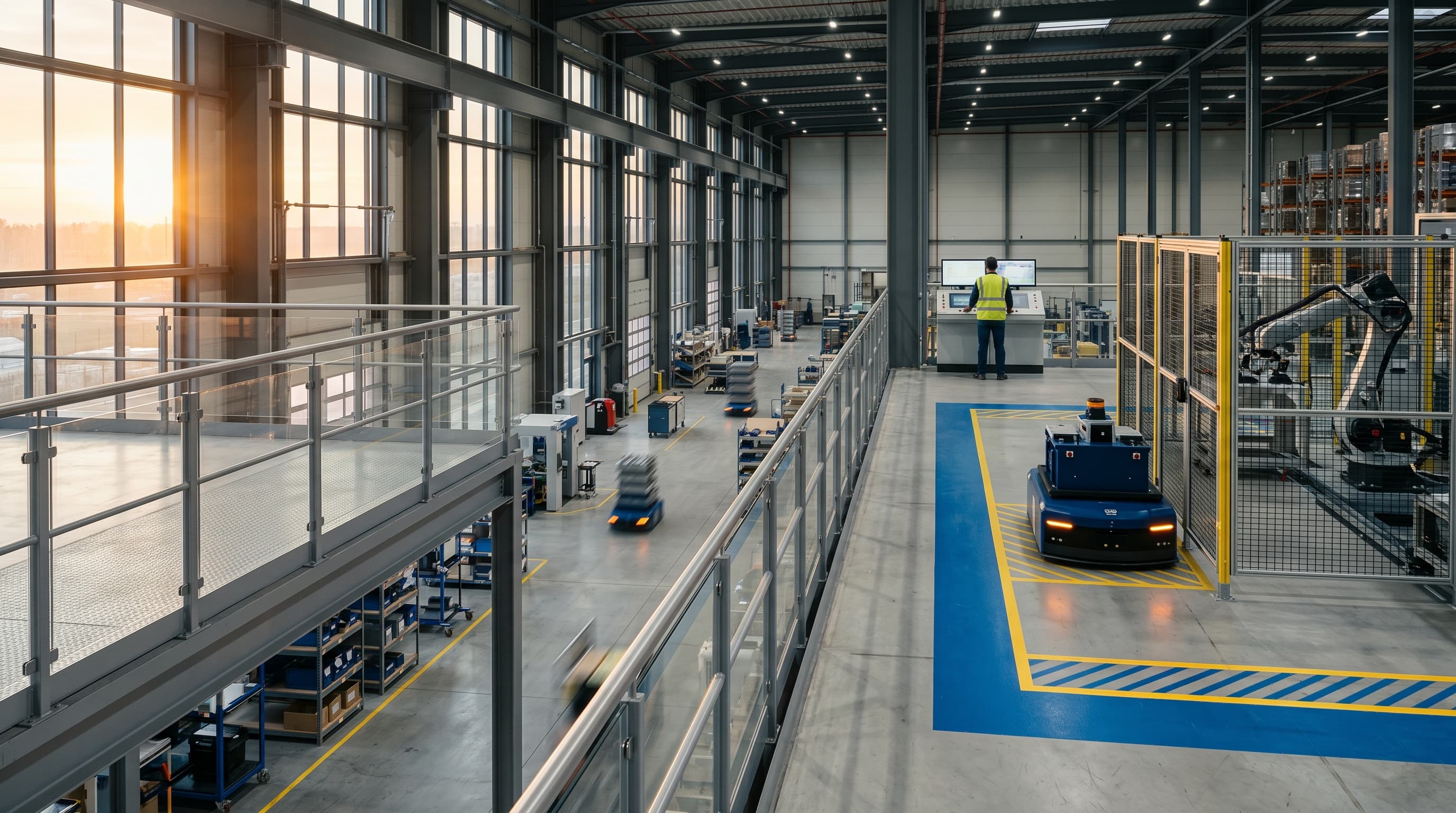
A robotics operations mezzanine overlooking AMRs and a governed machine-action boundary.

Physical AI control

Physical AI
runtime assurance.

Physical AI is one deployment surface for G‑14.
The governed-action model covers robots, drones, AMRs, humanoids, and industrial automation.
Each governed machine action can produce signed proof.

AllowHoldBlockReleaseProve

Physical systems

The governed-action model reaches embodied machines.

Use the same permit, hold, block, release, evidence, and verification loop across robots, drones, humanoids, warehouses, factories, data systems, cloud infrastructure, and regulated workflows.

01

Runtime gate

The control point in front of robot actions, fleet-manager commands, PLC calls, drone missions, and other high-consequence operations. It evaluates the action, applies allow/hold/block logic, enforces timeout and safe-state behavior, and records the release path.

02

Operator release layer

If an action needs human approval, G‑14 handles that release flow. The customer defines who can release what, under which conditions, and what happens if nobody responds in time.

03

Proof archive

Every governed action generates a signed packet: request, policy context, release decision, downstream receipt, canonical trace, evidence manifest, and verifier result.

04

Independent verifier

A customer, insurer, enterprise buyer, or outside reviewer can verify the packet without trusting the dashboard or runtime operators.

Deployment path

Connect, choose governed actions, define release, verify the packet.

The first deployment is practical: one robot stack, one set of high-risk actions, one release policy, and one proof export path.

  1. 1

    Connect G‑14 through adapters: ROS 2, Open-RMF, VDA 5050, PX4/MAVLink, PLC/webhook APIs, fleet managers, and dock systems.

  2. 2

    Choose which actions are governed: restricted-zone movement, pallet pickup, drone launch, arm actuation, teleop override, software update, route release, or mission start.

  3. 3

    Define the release policy: who can approve, what timeout applies, what evidence is required, and which safe state triggers on failure.

  4. 4

    At runtime, when the AI wants to act, G‑14 evaluates the request and allows, holds, or blocks it.

  5. 5

    After the step completes or fails, G‑14 emits the signed proof packet and verifier result.

  6. 6

    If there is a later dispute, the customer exports the packet and verifies it independently.

Signed action proof

Move the dispute from logs to signed action proof.

G‑14 proves the governed action path and evidence record. When stronger physical-outcome proof is needed, the packet can bind robot telemetry, controller receipts, camera hashes, sensor digests, dock receipts, and PLC acknowledgments.

  • Prove whether a high-consequence action was permitted before it happened
  • Prove whether an operator really released it
  • Prove whether timeout failed closed
  • Prove whether the evidence record is intact
  • Prove whether the governance record is internally inconsistent
requestpolicy contextrelease decisiondownstream receiptcanonical traceverifier result

Deployment phases

Start in shadow mode. Govern only after the customer trusts the trace.

Phase 1

Observe

Start in shadow mode. G‑14 does not block anything yet. It watches actions, emits canonical traces, and produces proof packets without disrupting operations.

Phase 2

Govern

Turn on active allow/hold/block for a narrow class of high-risk actions: restricted-area entry, human-zone interaction, teleop release, remote mission start, or hazardous equipment actuation.

Phase 3

Assure

Add exported proof archives, verifier receipts, and policy-backed release controls so the customer has an assurance product, not just operational middleware.

Product modules

Three modules make the offer easy to adopt.

G‑14 Control

Runtime permit-to-act, release rules, timeout, safe-state behavior, and audit trail.

G‑14 Proof

Signed evidence packets, canonical trace generation, archive export, and customer manifests.

G‑14 Verify

Independent verifier CLI/API, verifier receipts, dispute packages, and incident-review export.

G‑14 governs high-consequence autonomous AI actions and produces signed proof packets that independent verifiers can check. The same proof packet model applies when autonomous action touches machines.

First deployments

  • warehouse AMR deployments
  • industrial robot cells with human oversight
  • drone operators with mission approval requirements
  • robotics-as-a-service vendors selling into enterprise buyers
  • manufacturers needing customer-verifiable action records